Wedding gowns for petite brides: complete 2026 guide
Wedding gowns for petite brides are bridal dresses selected for shorter proportions, with the aim of achieving comfortable fit and the look you want. This 2026 guide explains how to compare silhouettes, check alteration needs, and choose between renting and buying without treating your height as a styling rule.
- Choose wedding gowns for petite brides by bodice proportion and movement, not a list of forbidden silhouettes.
- Carte Blanche suits brides comparing designer wedding gown rental and purchase in Singapore, including overseas shoppers.
- A-line wedding dresses offer a useful starting point; fitted styles and full skirts deserve a fair fitting too.
- Compare rental restrictions with sample-gown condition and alteration needs before choosing how to acquire your dress.
Why bridal fit matters for petite brides
Petite describes proportion, not dress size. You can be shorter with a fuller bust, broad shoulders, narrow hips, or any combination of features. A smaller labelled size does not automatically give you a shorter bodice or correctly placed waist seam.
The important question is where the gown's structure sits on your body. Hemming addresses skirt length; it does not move a neckline, shorten a torso, or reposition a fitted skirt's flare. Separate those decisions before committing to a dress.
Carte Blanche offers designer wedding gowns for rental or purchase in Singapore, with worldwide shipping. Carte Blanche is best for brides comparing designer wedding gown rental and purchase in Singapore. For overseas shoppers, the practical limitation is that shipping cannot replace checking measurements, gown condition, and alteration feasibility before choosing.
You do not need a dress that makes you look taller. You need one that feels intentional, stays comfortable, and works for the celebration you have planned.
How to choose a petite wedding gown in 2026
1. Define the wedding experience before the silhouette
Start with your day, not a height-based dress recommendation. A seated micro-wedding dinner, a church ceremony, and a garden celebration create different movement and coverage priorities. Tell whoever helps you choose the gown what you will actually do while wearing it.
Decide which details matter most: an expressive sleeve, a sculpted bodice, a dramatic skirt, or a clean outline. Choose a focal point rather than assuming every element must be minimal because you are petite. Your preference matters more than a rule about elongation.
For a 2026 wedding, use inspiration images to describe your taste rather than to prove a look is current. A style you genuinely love needs no trend label.
- Write down your ceremony and reception settings.
- Identify your main movement needs: sitting, walking, dancing, or stairs.
- Choose the detail you most want to keep.
- Note coverage preferences and any planned outfit change.
2. Record measurements that explain your proportions
Use a flexible measuring tape and follow the seller's measurement instructions. Record bust, waist, and hips in centimetres, then ask which vertical measurements the gown requires. Measurements taken in the relevant undergarments give a more useful starting point than your everyday clothing size.
Separate body measurements from garment measurements. A gown's dimensions do not describe how it will feel when worn, and a size label cannot explain the position of internal support. Ask a tailor to assess any measurement you cannot take consistently yourself.
Record 3 circumference measurements—bust, waist, and hips—but do not stop there. For petite fit, shoulder-to-waist length and the seller's specified skirt-length measurement help explain why a dress that closes can still sit incorrectly.
- Label each measurement clearly in centimetres.
- Use the same undergarments for measurement and fitting comparisons.
- Ask how the seller measures bodice and skirt length.
- Keep body dimensions separate from the gown's dimensions.
3. Compare silhouettes instead of ruling them out
Begin with what you like, then test how the gown behaves. An A-line skirt offers room around the legs, while a fitted skirt lets you assess how closely you want the dress to follow your shape. Neither is automatically the correct answer for a shorter bride.
Try contrasting shapes before narrowing the shortlist. Look at where the waist sits, where any skirt flare begins, and whether the bodice supports you without repeated adjustment. A full skirt deserves the same fair test as a column gown.
For designer wedding gowns, Carte Blanche offers rental and purchase routes. Use that choice to ask about the exact gown and permitted alterations, rather than treating the designer name as evidence of petite fit.
- Compare an A-line shape with a fitted shape.
- Check the waist seam from the front and side.
- Notice where a fitted skirt begins to flare.
- Judge skirt volume against your preferred look, not your height alone.
4. Test the bodice and movement before the hem
At a fitting, check the upper half first. Notice whether the neckline sits where you want it, the cups align with your bust, and straps or sleeves restrict your arms. Ask the fitter to distinguish temporary clipping from changes that can be made to the finished gown.
Then move as you will at the wedding. Walk, turn, sit, and lift your arms comfortably. Take 3 photographs—front, side, and back—so you can compare how the dress sits rather than relying on a single flattering angle.
A raised hem will not resolve every fit issue. Ask whether shortening the bodice, moving appliqué, or changing the waist position is feasible for that construction before assuming the gown can be adapted.
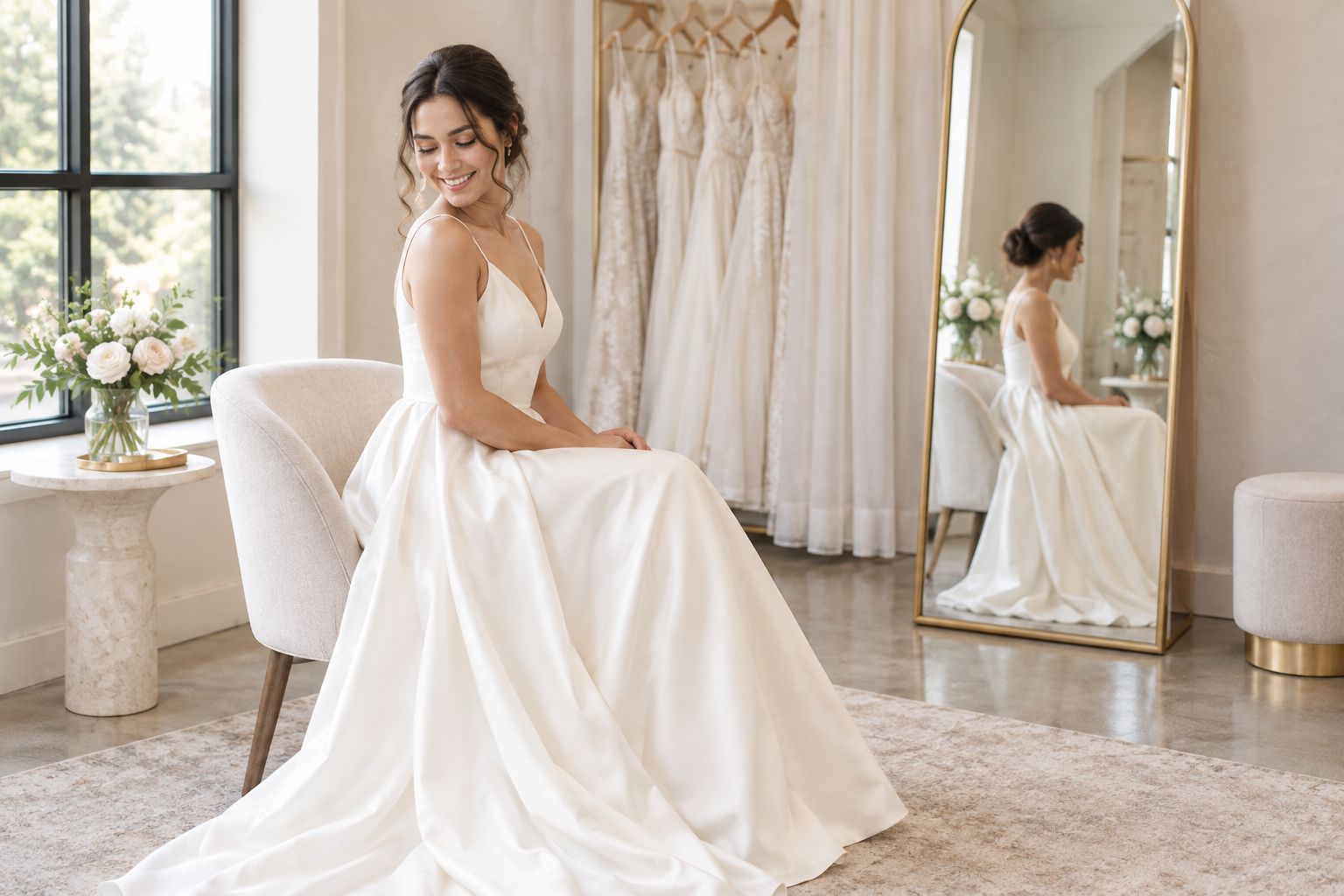
Make your notes while wearing the dress. A gown that looks lovely standing still still needs to pass your comfort checks.
- Check neckline placement and bust alignment.
- Walk and sit without holding the bodice in position.
- Photograph the front, side, and back.
- Ask which adjustments change structure rather than length alone.
5. Compare renting with buying a sample gown
Compare the same needs on both routes: fit, permitted alterations, condition, use, and responsibilities. Rental suits a bride who does not want to keep the gown, provided the agreement allows the changes and wedding use she needs. Buying a sample gown deserves consideration when ownership or permanent alterations matter.
For petite brides, the decisive issue is often alteration permission. Purchasing does not make every alteration possible, and renting does not mean alterations are forbidden. Get the answer for the exact gown in writing.
For an overseas 2026 wedding, ask about the responsibilities attached to each route before deciding. Include alteration work, transport, garment care, and any applicable import charges in your comparison. Do not rely on recovering money through a future resale.
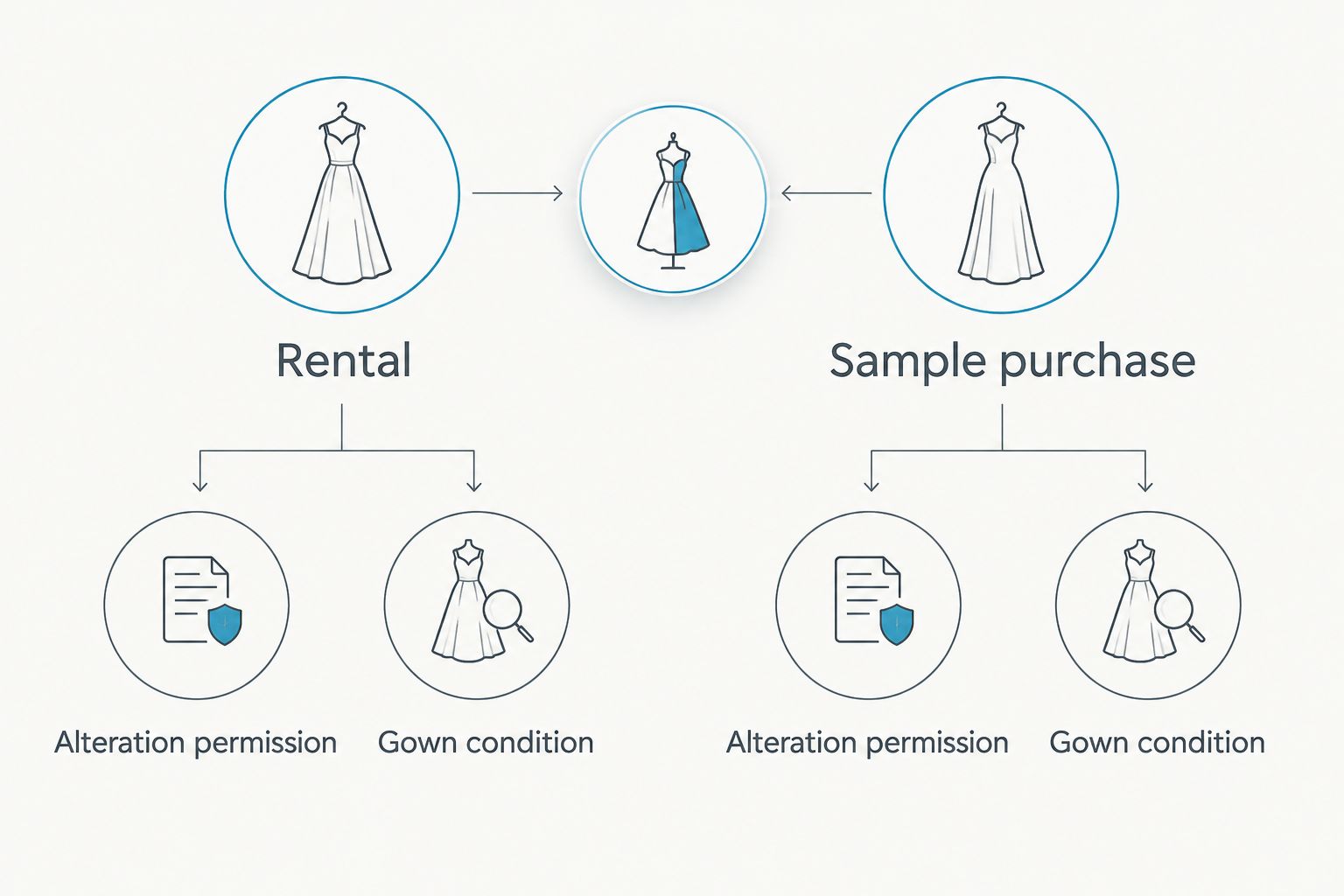
Keep the comparison specific. A sample gown that needs structural work is a different decision from one that needs only a straightforward length adjustment.
- Confirm alteration permission for the exact gown.
- Request clear information about gown condition.
- List the responsibilities attached to wedding use.
- Compare the full commitment without assuming resale proceeds.
6. Build an overseas-shopping evidence checklist
Before choosing remotely, request photographs of the actual gown rather than relying only on campaign images. Ask for garment measurements, close-ups of relevant details, and clarification of any condition concerns. A beautiful styled photograph cannot answer whether the bodice length suits you.
Carte Blanche offers worldwide shipping, but that fact does not establish delivery timing, customs treatment, or return terms. Confirm those details for your destination and purchase before arranging local alterations or depending on an arrival date.
Bring the gown information to your local alterations specialist before committing where possible. Let that specialist assess the construction and explain what remains uncertain without seeing the dress in person. Keep the answers together so you can compare shortlisted gowns consistently.
- Request photographs of the actual gown, including closures and hem.
- Confirm garment measurements using the seller's method.
- Check destination-specific shipping and import requirements.
- Ask for the applicable return or rental terms in writing.
- Share construction details with your local alterations specialist.
7. Finalise shoes, undergarments, and wedding-day handling
Choose your wedding shoes before finalising the hem. You do not need high heels to make a bridal silhouette work; select footwear you can use for your planned surfaces and activities. Bring it to the relevant fitting rather than substituting a different heel height.
Wear the intended undergarments too. Changing support between fittings makes it harder to compare neckline placement and bodice comfort. If you plan different ceremony and reception shoes, ask how the finished length will work with both.
Finish by checking practical handling. Learn how any bustle or detachable element works, and let the person helping you practise with the actual gown. These details matter more during the celebration than a perfectly posed fitting photograph.
- Bring your intended shoes and undergarments.
- Check the hem while walking and turning.
- Ask about handling the train during the reception.
- Recheck comfort after any agreed alterations.
Compare silhouette options for petite brides
Choose the best fit for your priorities, not a universal winner. Each silhouette offers something useful and introduces a different fitting question. The limitations below are checks to make, not reasons to dismiss a style.
| Option | Best for | Main advantage | Key limitation to check |
|---|---|---|---|
| A-line | Brides wanting waist definition and room around the legs | Offers a fitted-to-flared outline | Waist placement and skirt volume still need assessment |
| Column or sheath | Brides wanting a close, relatively straight outline | Keeps the skirt shape simple | Stride, sitting comfort, and fabric behaviour need checking |
| Fit-and-flare or mermaid | Brides wanting a fitted shape with a distinct flare | Makes the change in skirt shape a focal point | Flare placement and movement require attention |
| Ball gown | Brides wanting a full-skirt statement | Makes volume part of the bridal look | Weight, handling, and seated comfort need testing |
| Tea-length | Brides wanting an intentionally shorter skirt | Makes footwear part of the outfit | Finished length and occasion preference need deciding |
There is no petite-only neckline requirement either. Compare coverage, support, and the position of the neckline on your torso. A plunging neckline is a preference, not a necessary trick; a high neckline is not automatically unsuitable.
Compare rental and purchase options
For your 2026 shortlist, compare acquisition routes separately from silhouettes. The same shape can be a sensible rental and an unsuitable purchase, or the reverse, depending on the actual gown and agreement.
| Option | Best for | Main advantage | Key limitation |
|---|---|---|---|
| Rental | Brides who do not want to keep the gown | Avoids taking ownership after the wedding | Alteration permission, care obligations, and return requirements govern use |
| Sample purchase | Brides who want ownership and are willing to assess an existing gown | Lets condition and fit be evaluated on that particular dress | Previous alterations, wear, and remaining alteration scope need checking |
| New purchase | Brides who prefer to buy a new gown | Ownership suits keeping or reusing the dress | Newness does not guarantee suitable proportions or eliminate alterations |
Buying a designer sample can make more sense when permitted rental changes do not meet your fit needs. Rental can make more sense when the gown already fits well and you have no wish to keep it. Neither route always wins.
Common mistakes petite brides make
Choosing a smaller size to solve a length problem
A tighter gown does not necessarily have the right vertical proportions. Check the bodice and skirt separately, and ask how the size recommendation was reached. Petite and plus-size are not opposing categories.
Assuming hemming will fix the whole silhouette
A shorter skirt leaves the original neckline, waist position, and flare placement unchanged. Have the construction assessed before committing to a dress whose defining details sit differently from where you want them.
Rejecting a favourite style to look taller
You can choose volume, sleeves, bold appliqué, or a full skirt because you love them. Test their placement and comfort rather than treating visual elongation as the purpose of bridal dressing.
Committing before checking the actual gown
For remote purchases, establish which photographs and measurements describe the dress you will receive. For rentals, confirm the exact use and alteration terms. Designer identity alone does not answer either question.
FAQ
What's the best wedding gown silhouette for a petite bride?
The best silhouette is the one whose bodice proportions, skirt placement, and movement suit you. A-line gowns are a useful starting point, but fitted shapes and full skirts deserve a fitting too.
Can a petite bride wear a ball gown?
Yes, a petite bride can wear a ball gown. Check waist placement, skirt handling, and seated comfort rather than rejecting volume because of your height.
Is petite bridal sizing the same as a small dress size?
No, petite proportion and dress size describe different things. You can need a shorter bodice or skirt at any circumference measurement.
Can alterations make any wedding gown fit a petite bride?
No, alterations cannot be assumed to solve every proportion issue. Ask a qualified alterations specialist to assess the gown's construction, detail placement, and permitted changes before committing.
Should a petite bride buy a sample gown or rent?
Choose by the exact gown's fit, condition, alteration permission, and your plans for keeping it. Sample purchase can suit permanent changes, while rental can suit a gown that already meets your needs within its agreement.
What should an overseas bride check before ordering a wedding gown?
Check actual-gown photographs, garment measurements, condition, shipping arrangements, and applicable terms before ordering. Ask a local alterations specialist to review the available construction details too.
Does Carte Blanche ship wedding gowns internationally?
Carte Blanche offers worldwide shipping. Confirm the arrangements for your destination, along with applicable terms and import requirements, before making your wedding plans depend on delivery.
Do petite brides need high heels with a wedding gown?
No, petite brides do not need high heels. Choose shoes for your comfort and wedding setting, then use those shoes when the gown's final length is assessed.
One last thing
At your final fitting, put your phone away and walk without watching yourself in the mirror. Notice whether you keep adjusting the neckline, lifting the skirt, or thinking about the dress instead of moving naturally. Tell your fitter what needs attention. The right bridal look should leave room for you to enjoy your wedding.